Ipamorelin Reconstitution Calculator

Use this free calculator to reconstitute Ipamorelin for research: enter the milligrams in your vial and the millilitres of bacteriostatic water, and it returns the concentration in mg/mL, the volume to draw for any target, and the U-100 unit equivalent. The reference data and concentration matrix below are specific to Ipamorelin and can be checked by hand or cited.

Ipamorelin reference data

Class Growth-hormone secretagogue / ghrelin-receptor peptide (pentapeptide, 5-mer)
Molecular formula C38H49N9O5
Molecular weight 711.9 g/mol
CAS 170851-70-4
PubChem CID 9831659
Typical vial sizes 5 mg / 10 mg
Storage Lyophilized: -20 C sealed and desiccated, out of light. Reconstituted: 2-8 C, protect from light; typical ~4-week refrigerated working window.

Concentration matrix for Ipamorelin

Each cell = concentration for that vial mass and diluent volume, with mcg per U-100 unit and nmol/mL (from MW 711.9). Concentration = vial mg ÷ water mL.

Vial ↓ / Water → 1 mL 2 mL 3 mL 5 mL
5 mg 5.00 mg/mL
50.0 mcg/unit · 7023 nmol/mL
2.50 mg/mL
25.0 mcg/unit · 3512 nmol/mL
1.67 mg/mL
16.7 mcg/unit · 2341 nmol/mL
1.00 mg/mL
10.0 mcg/unit · 1405 nmol/mL
10 mg 10.00 mg/mL
100.0 mcg/unit · 14047 nmol/mL
5.00 mg/mL
50.0 mcg/unit · 7023 nmol/mL
3.33 mg/mL
33.3 mcg/unit · 4682 nmol/mL
2.00 mg/mL
20.0 mcg/unit · 2809 nmol/mL

Handling & notes

Good aqueous solubility for a small peptide; the lysine residue and C-terminal amide keep it hydrophilic, so plain sterile or bacteriostatic water suffices with no co-solvent and no acidified diluent.

At 711.9 g/mol Ipamorelin is the smallest peptide in this calculator set — roughly one-seventh the mass of tesamorelin — which is why it hydrates fastest and why its molar figures run an order of magnitude higher at the same mass concentration. A 5.00 mg/mL Ipamorelin solution is about 7,023 nmol/mL; 5.00 mg/mL of tesamorelin is about 974 nmol/mL. When comparing two different peptides, molar concentration is the comparable number, not mg/mL.

Technique. Run the diluent down the inside wall of the vial rather than jetting it onto the cake. Swirl or roll until dissolved; do not shake or vortex — foaming drives peptide to the air-liquid interface and mechanically stresses the chain. A clear, colorless solution inside about a minute is normal. Ipamorelin does not typically gel, cloud, or leave lasting particles the way larger or less soluble peptides can.

Choosing a volume. The peptide dissolves cleanly across the whole 1-5 mL range, so diluent volume is a measurement-convenience decision rather than a solubility constraint. More water lowers the mcg carried by each U-100 unit, which gives finer resolution per graduation on the syringe barrel.

Storage. Lyophilized at -20 C, sealed and desiccated, out of light. Reconstituted at 2-8 C, protected from light, typical working window about four weeks. Discard any solution that turns cloudy or discolored or carries visible floating particles.

Worked example: Ipamorelin

A 10 mg vial reconstituted with 2 mL of bacteriostatic water, worked through step by step:

  • Concentration: 10 mg ÷ 2 mL = 5.00 mg/mL
  • Per U-100 unit (1 unit = 0.01 mL): 5.00 mg/mL × 0.01 mL = 0.05 mg = 50 mcg per unit
  • Molarity: (5.00 ÷ 711.9) × 1,000,000 = 7,023 nmol/mL
  • A 0.10 mL draw (10 units on a U-100 barrel) carries 0.5 mg = 500 mcg
  • Total yield: 2.00 mL of solution = 200 U-100 units in the vial

Halving the water to 1 mL doubles every concentration figure and halves the total unit count; the milligrams in the vial never change.

Ipamorelin reconstitution FAQ

Does Ipamorelin need an acidified diluent?
No. It is a small, freely water-soluble pentapeptide, so plain bacteriostatic or sterile water dissolves it without acetic acid or any other co-solvent. Acidified diluents are reserved for peptides that will not hydrate in neutral water.

How is the nmol/mL figure derived?
Divide the concentration in mg/mL by the molecular weight in g/mol, then multiply by 1,000,000. For Ipamorelin at 5.00 mg/mL: (5.00 / 711.9) x 1,000,000 = 7,023 nmol/mL. The molecular weight used here is 711.9 g/mol.

Does adding more water make the vial weaker?
It lowers the concentration, not the total mass. A 10 mg vial holds 10 mg whether it is mixed into 1 mL or 5 mL; the water only decides how many milligrams occupy each millilitre, and therefore how many mcg sit in each U-100 unit.

Why does Ipamorelin show much higher nmol/mL than the larger peptides?
Because molarity is mass divided by molecular weight. At 711.9 g/mol Ipamorelin is a fraction of the mass of a 40-residue peptide, so the same milligram figure represents far more molecules.

What is the difference between bacteriostatic and sterile water here?
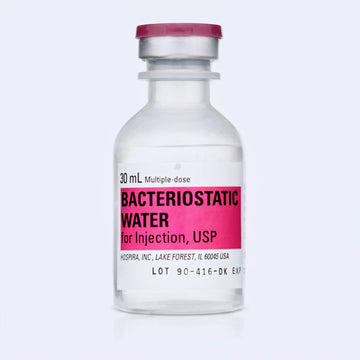
Bacteriostatic water contains 0.9% benzyl alcohol as a preservative, which is what allows a vial to be entered more than once across a refrigerated storage window. Plain sterile water has no preservative and is a single-entry diluent. Neither changes the concentration arithmetic.

All values here are physical-chemistry reference data and fluid-mixing arithmetic for laboratory and research use only. Not dosing, medical, or therapeutic guidance; not intended for human or animal use. Products are sold for research, educational, and demonstration use only.

For research and educational use only. Preppin Peppers sells laboratory hardware and materials (reconstitution pens, cartridges, and bacteriostatic water), not peptides or anything for consumption. All content here, including the calculators, is educational and is not medical, veterinary, dosing, or compounding advice. It has not been evaluated by the FDA and is not intended to diagnose, treat, cure, or prevent any condition, or for human or animal use. You are responsible for complying with your local laws, and use is at your own risk.

Peptide Reconstitution Calculator

Enter your vial and the bacteriostatic (or sterile) water you added, then see exactly how many units to draw. Toggle mg or mcg, and hover any ? for help.

Concentration?How concentrated the mixed solution is: milligrams of peptide per millilitre.5.0 mg/ml
Volume to draw?The millilitres you would draw to get your target amount.0.05 ml
Draw on a U-100 scale?The same volume in units on a standard U-100 syringe or pen. 1 unit = 0.01 ml.5 units
Per unit?How much peptide one unit on a U-100 syringe delivers at this concentration.50 mcg
Draws per vial?How many target-size draws one vial holds, rounded down.10

1 unit on a U-100 syringe or pen = 0.01 ml. 1 mg = 1000 mcg. Illustrative fluid math for research reconstitution.

How to reconstitute your vial

Reconstitution is adding liquid, almost always bacteriostatic water, to a freeze-dried (lyophilized) peptide so it can be measured accurately.

  1. Clean both stoppers. Wipe the bacteriostatic water vial and the peptide vial with an alcohol swab before puncturing either one.
  2. Draw the water first. Pull the full amount of bacteriostatic water into the syringe before adding anything to the peptide vial.
  3. Add the water slowly. Aim the stream down the inside wall of the vial instead of blasting the powder directly.
  4. Swirl gently. Roll or swirl the vial until the powder dissolves fully. Never shake it hard.
  5. Refrigerate after mixing. Keep the reconstituted vial cold and away from light unless the label says otherwise.

Get your target amount from a licensed provider. This calculator handles the arithmetic, not the protocol.

How the math works

The peptide dissolves evenly in the water you add, so the concentration is simply the milligrams in the vial divided by the millilitres of water. U-100 syringes are marked in units, and 100 units equal 1 ml. The three formulas this calculator uses:

  • Concentration (mg/ml) = vial mg ÷ water ml
  • Units to draw = (target mcg ÷ (vial mg × 1000)) × water ml × 100
  • Draws per vial = (vial mg × 1000) ÷ target mcg, rounded down

Example: a 5 mg vial reconstituted with 2 ml of bacteriostatic water is 2.5 mg/ml, or 25 mcg per unit. A 250 mcg target is 10 units on a U-100 syringe (0.10 ml), and the vial holds 20 draws.

Peptide Cycle Calculator & Supply Planner

Add a card per peptide with its amount, schedule, and cycle length, then export to your calendar. Hover any ? for help.

Research supply & scheduling math only. This peptide cycle calculator maps a research schedule and its resupply math — the vials and cartridges a planned run needs, reconstitution timing, and what is left over. It is not a dosing schedule, a protocol, or medical or veterinary advice. Obtain any target amounts and administration guidance from a licensed provider.
Imports into Google Calendar, Apple Calendar and Outlook.

Generated in your browser and never stored. For research planning and supply estimation only, not dosing guidance.

DIY Peptide Blend Calculator

Mixing in one cartridge? Combining peptides is a stability question, not just a volume one. Some stay stable together, others degrade faster, and any blend shortens the beyond-use window. If compatibility is unknown, reconstitute separately or keep short-dated blends cold. This tool handles the volumes once you have decided what can share a cartridge.

Combine peptides into one cartridge and see the draw for each. Hover any ? for help.

Solution in cartridge?The combined volume of the reconstituted solutions you draw into the cartridge.—
Top-up water?Plain bacteriostatic water added last when Fill cartridge is on. With no top-up this shows the spare room left in the cartridge.—
Each draw?The volume of one draw in U-100 units and millilitres. With no top-up it is the blended solution divided by draws; with Fill cartridge it is the cartridge size divided by draws.—
Each draw contains—

Assumes each peptide dissolves fully and mixes evenly. Shelf life varies by peptide and handling; research planning math only, not dosing, compounding, or storage guidance. Confirm your protocol and storage with a licensed provider.

Pairs with our hardware

Everything these tools are built around

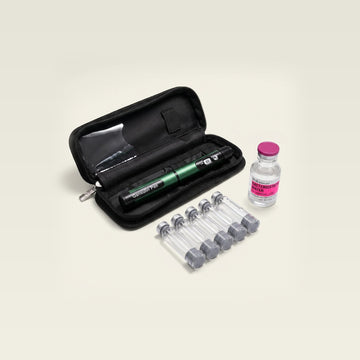
Reusable all-metal pens, standard 3 ml glass cartridges, and USP bacteriostatic water — the hardware and diluent the calculators assume.